
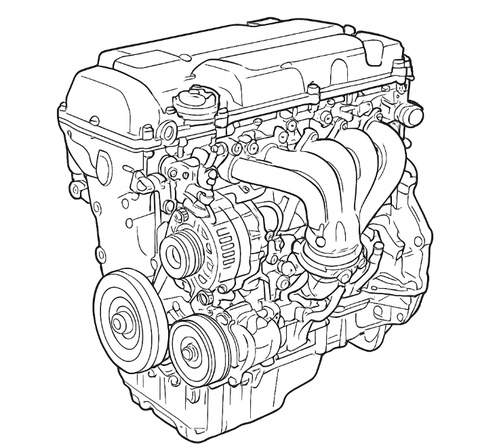
Factory repair and maintenance manual for the Mercedes-Benz OM647 DE27LA engine (2.7L, 5-cylinder CDI). Includes complete instructions for diagnostics, common rail fuel system repair, turbocharger maintenance, and technical specifications such as compression ratio (19:1) and firing order (1-2-4-5-3).
| DESCRIPTION | SPECIFICATION |
|---|---|
| Engine | 2.7L CDI |
| Engine Description | 5 Cylinder In-Line Engine With 4-Valve Technology |
| Air Intake | Turbo-Charged Engine with Charge Air Cooling |
| Fuel Injection System | Common Rail Diesel Injection (CDI) |
| Fuel | Diesel |
| Firing Order | 1-2-4-5-3 |
| Rated Output | 125/4200 kW at RPM |
| Torque | 400/1600-2400 Nm at RPM |
| Maximum Speed | 4800 RPM |
| Compression Ratio | 4800 (Output) |
| Bore/Stroke | 88.0/88.4 mm |
| Eff. Displacement | 2688 cm3 |
| Password for PDF: truckfixdiagn.com | |
| OM647 DE27LA Engine Lubrication & Maintenance | Download |
| OM647 DE27LA Engine Cooling. Diagnosis and Testing Cooling System | Download |
| OM647 DE27LA Engine Electronic Control Modules | Download |
| OM647 DE27LA Engine Systems, Battery, Charging, Starting | Download |
| OM647 DE27LA Engine Ignition Control | Download |
| OM647 DE27LA Engine Instrument Cluster. Temperatue, Fuel Gauge | Download |
| OM647 DE27LA Engine Speed Control | Download |
| OM647 DE27LA Engine 2.7L CDI Service Manual | Download |
| OM647 DE27LA Engine Exhaust System. Catalytic Converter | Download |
| OM647 DE27LA Engine Fuel System. Diagnosis and Testing | Download |
| OM647 DE27LA Engine Emissions Control. Valve | Download |
Typical problems and weaknesses of the OM647 diesel engine
1. Injector Problems and Exhaust Leaks
- "Black Death": This is the most common problem. Failure of the sealing washers (copper) under the injectors leads to exhaust gas and soot leaks.
- Symptoms: Thick black carbon deposits around the injector, which may resemble tar, and a characteristic burning smell in the cabin.
- Consequences: If the problem is not corrected, the carbon hardens and "seals" the injector into the cylinder head, making its removal extremely difficult, expensive, and often leading to cylinder head damage.
2. Common Rail (CDI) Problems
- Fuel Pressure Sensor (in the Rail): Failure of this sensor can cause difficult starting of the engine, especially when hot, or sudden stalling while driving.
- Fuel Pressure Regulator: A faulty regulator on the high-pressure fuel pump (HPFP) can also cause unstable pressure and starting problems.
3. Mass Air Flow Sensor (MAF)
- Dirty MAF: The mass air flow sensor (MAF) often becomes dirty, causing inaccurate readings.
- Symptoms: Reduced power, poor traction, black smoke from the exhaust, and increased fuel consumption.
4. Oil and Gasket Leaks
- Turbocharger Leaks: The O-rings in the turbocharger's oil supply system harden over time and begin to leak oil.
- Hose Seals: Pressurized air leaks in the turbocharger (Air Intake) system can occur due to worn O-rings on the intercooler hoses.
5. Electronic and other problems
- Vibrations (at idle): May be caused by worn engine mounts or injector balancing issues.
- Vacuum system problems: Malfunctions in vacuum lines or valves can affect the operation of the turbocharger (if equipped with a vacuum actuator) and other actuators.
Write a comment