
Master your vehicle's electronics with the definitive Isuzu D-Max 2007-2010 Electrical System Service Manual. This comprehensive guide provides essential wiring diagrams, component locations, and troubleshooting procedures for both 2WD and 4WD models.
What’s Included in This Manual:
-
Complete Wiring Diagrams: Detailed schematics for the entire electrical network, including engine management and chassis circuits.
-
Fuse & Relay Mapping: Comprehensive tables for the interior and engine bay fuse boxes, covering critical components like the ECM, TCM, and ABS.
-
Component Locations: Precision guides to finding sensors, control modules (ECU/ECM), and ground points.
-
Lighting Systems: Full circuits for Headlamps (Hi/Lo), Tail Lamps, Stop Lamps, and Cornering Lamps.
-
Power Accessories: Wiring for Power Windows, Door Locks, Mirror Heaters, and the Audio/ACC system.
-
Engine Electrical: Dedicated diagrams for the Starter, Fuel Heater (4JJ1/4HK1), and Charging System.
Perfect for Troubleshooting Common Issues:
Whether you are diagnosing a faulty Wiper Main circuit, tracing a Cigar Lighter short, or repairing the Blower Motor for the HVAC system, these diagrams provide the factory-standard accuracy needed for a professional repair.
| Password for PDF: truckfixdiagn.com | |
| Isuzu D-Max 2007-2010 Wiring Diagram. Electrical System | Download |
| Isuzu D-Max 2007-2010 Fuse and Relay diagram | Download |
| Engine 4JJ1-TC, 4JK1-TC Part Location | Download |
| Removal and Installation ECM C24SE (Engine Control Module) | Download |
| Battery Inspection and Replacement | Download |
| Grounding Point Location C24SE/HFV6 | Download |
| Isuzu D-Max 2007-2010 Cable Harness Routing | Download |
| Isuzu D-Max 2007-2010 Bulb Specification | Download |
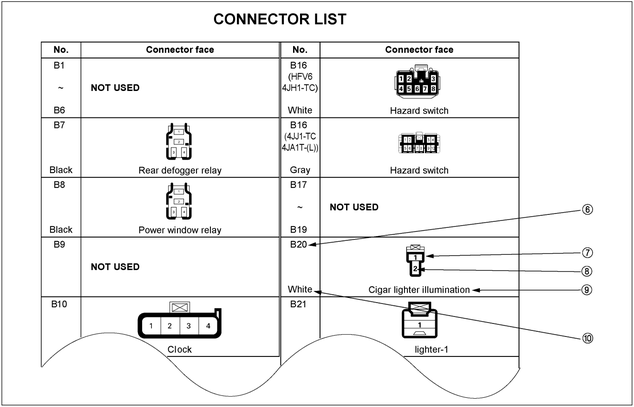
Connector List
Typical Electrical and Sensor Problems
Starting and Charging System Issues
-
Starter Relay Failure: Oxidation or wear on the Starter Relay (Relay No. 1) can cause intermittent starting or a "click" sound without the engine cranking.
-
Charging Circuit Faults: Issues with the Charge (Eng Run) fuse (No. 11) may trigger battery warning lights on the dashboard even if the alternator is functional.
Engine Management and Sensor Problems (ECM/TCM)
-
ECM Power Loss: Blown fuses for the ECM Main (Fuse No. 3, 10A for 4HK1 engines) or the general ECM circuit (Fuse No. 20 in the main block) can cause sudden engine stalling or a "no-start" condition.
-
Transmission Sensor Errors: Faults in the Parking/Neutral circuit (Fuse No. 5) or the TCM (A/T models) fuse (No. 4) often lead to the transmission entering "limp mode" or preventing the starter from engaging.
-
SCR & Fuel Heating: For specific diesel variants, failure of the SCR Water Valve (Relay No. 5) or the Fuel Heater (Relay/Fuse No. 9/3 for 4JJ1) can trigger emissions-related error codes and poor cold-start performance.
Lighting and Visibility Issues
-
Total Tail Light Failure: If both rear lights fail, it is often due to the Tail Main fuse (No. 2, 20A) or the specific Tail Lamp fuse (No. 16).
-
Headlamp Circuit Malfunctions: Independent fuses for Headlamp Lo (No. 13) and Headlamp Hi (No. 15) mean a single short circuit can take out one set of beams while the others remain functional.
-
Stop Lamp & Shift Interlock: A blown Stop Lamp fuse (No. 1) not only disables brake lights but can also prevent automatic models from shifting out of "Park".
Auxiliary and Comfort System Faults
-
Wiper Motor Protection: The Wiper Main (Fuse No. 6) and Wiper Hi Lo (Fuse No. 8) are prone to blowing if the wipers are activated while frozen to the windshield.
-
Blower Motor Overload: The Blower Motor fuse (No. 20) frequently fails if the cabin filter is clogged or the motor brushes are worn, causing the AC/Heater fan to stop working.
-
Accessory Power: The Cigar Lighter (Fuse No. 18) and Power ACC (Fuse No. 19) are common failure points when using high-draw aftermarket chargers or compressors.
Write a comment